
When comparing omega-3 supplements, you will often see two important fatty acids listed on the label: EPA (eicosapentaenoic acid) and DHA (docosahexaenoic acid). Both are found in oily fish and fish oil supplements, and both contribute to important functions in the body. However, they are not identical.
Some omega-3 products provide more EPA, while others contain more DHA or a balanced combination of the two. Understanding the difference can help you compare supplements more accurately instead of choosing a product based only on the number printed on the front of the bottle.
This guide explains what EPA and DHA do, how they differ, how much omega-3 adults may need, and what UK guidance says about dietary sources and supplement safety.
Who this guide is for
This guide may be useful for:
UK adults comparing omega-3 fish oil supplements
People who want to understand EPA and DHA amounts on supplement labels
Readers interested in heart, brain and eye health
People comparing standard fish oil with concentrated omega-3 products
Anyone trying to increase their omega-3 intake through food or supplements
This article is for general educational purposes only. It does not diagnose, prevent or treat medical conditions.
What are EPA and DHA?
EPA and DHA are long-chain omega-3 polyunsaturated fatty acids. They are found naturally in oily fish and seafood, and are available in some fish oil and algae-based supplements.
Although they belong to the same family, they have different structures and roles in the body.
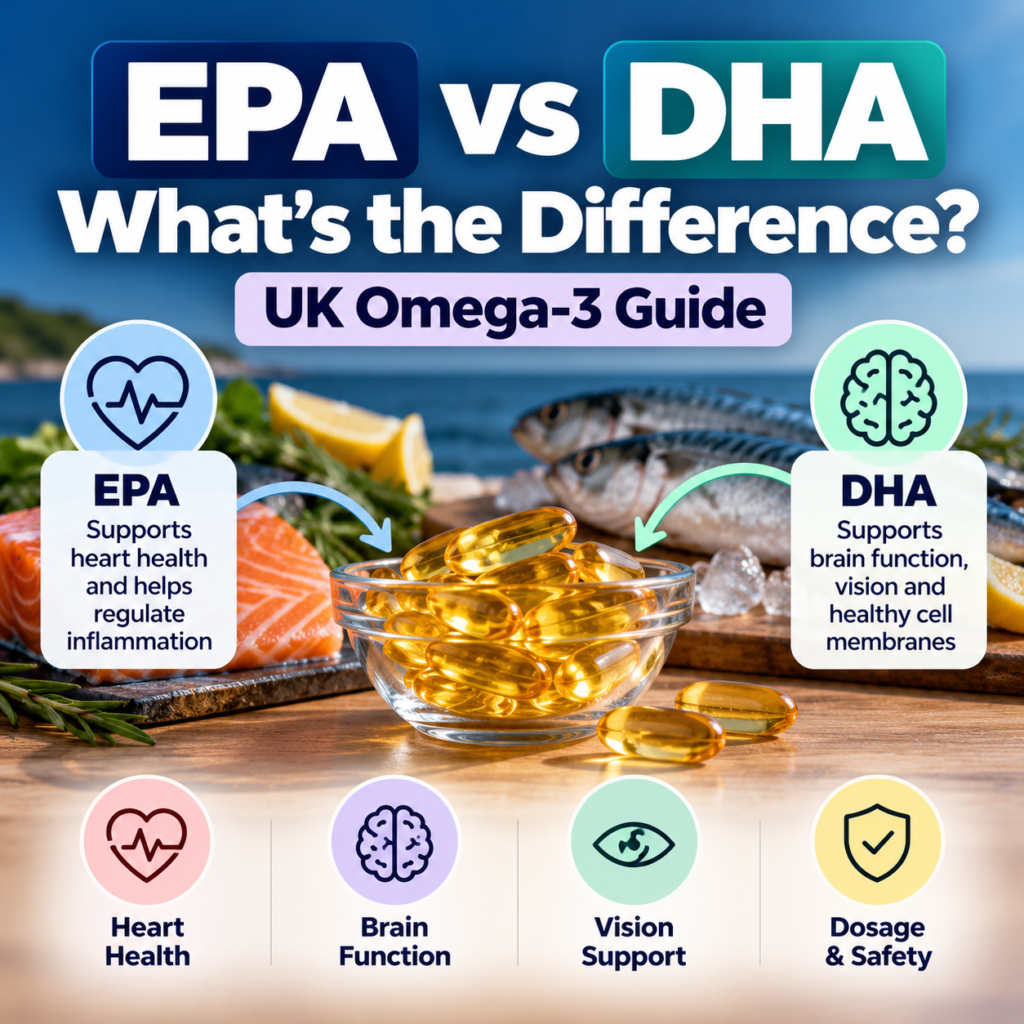
EPA is involved in producing signalling molecules that help regulate processes such as inflammation.
DHA is an important structural component of cell membranes, particularly in the brain and retina of the eye.
The body can convert small amounts of one omega-3 fatty acid into another, but this conversion is limited. This is one reason EPA and DHA are usually considered separately when evaluating dietary intake and supplement formulations.
EPA vs DHA: what’s the difference?
| Feature | EPA | DHA |
|---|---|---|
| Full name | Eicosapentaenoic acid | Docosahexaenoic acid |
| Main role | Involved in cell signalling and inflammatory regulation | Important structural component of brain and retinal cell membranes |
| Common food sources | Oily fish and seafood | Oily fish and seafood |
| Supplement availability | Fish oil and some algae-derived products | Fish oil and algae-derived products |
| Research interests | Cardiovascular health and triglyceride management | Brain development, vision and cardiovascular health |
| Common supplement formulation | Often included in EPA-focused or balanced formulas | Often included in DHA-focused or balanced formulas |
| Is one universally better? | No | No |
Neither fatty acid is universally superior. The appropriate intake depends on diet, the reason for supplementation and individual circumstances.
What does EPA do?
EPA is an omega-3 fatty acid involved in the production of signalling compounds called eicosanoids and other lipid mediators. These compounds participate in the regulation of several biological processes, including inflammation.
EPA has been studied extensively in relation to cardiovascular health.
EPA and heart health
EPA is found in many fish oil supplements marketed for heart health. Research has examined omega-3 fatty acids in relation to blood triglyceride levels and cardiovascular outcomes.
The evidence depends on the formulation, dose and population being studied. Prescription omega-3 medicines used for specific medical purposes should not be equated with ordinary over-the-counter fish oil supplements.
The authorised European health claim states that EPA and DHA together contribute to the normal function of the heart when consumed at a combined intake of 250 mg per day.
This does not mean that taking more EPA automatically produces greater cardiovascular benefits.
EPA and inflammation
EPA is involved in biological pathways that help regulate inflammatory responses. This is an important area of scientific research, but it should not be interpreted as proof that an ordinary EPA supplement treats inflammatory diseases.
If you are considering omega-3 for a medical condition, discuss the evidence and appropriate treatment with a qualified healthcare professional.
What does DHA do?
DHA is a major structural component of cell membranes, particularly in the brain and retina. It is especially important during periods of rapid development, including pregnancy and early childhood.
DHA and brain health
DHA is present in high concentrations in the brain. Researchers have investigated its role in brain development, cognitive function and healthy ageing.
However, the fact that DHA is structurally important to the brain does not mean that taking a DHA supplement will necessarily improve memory, concentration or prevent age-related cognitive decline in every adult.
Results from supplementation studies vary depending on the population, dietary intake, dose and outcome measured.
DHA and vision
DHA is an important component of the retina. It contributes to normal brain and eye function, and an authorised European health claim states that DHA contributes to the maintenance of normal vision when the daily intake reaches 250 mg.
This is a nutrient-function claim, not a claim that DHA supplements treat eye disease or improve eyesight beyond normal function.
DHA during pregnancy
DHA is important for normal fetal brain and eye development. Pregnant and breastfeeding people should seek advice from a midwife, GP or pharmacist about appropriate dietary sources and supplements.
Choose products carefully and follow UK pregnancy guidance, particularly regarding fish species, fish liver oils and vitamin A.
Is EPA or DHA better for heart health?
Neither is automatically better for every person.
Both EPA and DHA have been studied in cardiovascular research, but their effects can differ depending on the outcome and formulation. For example, some prescription EPA-only medicines have been studied in specific groups of people at elevated cardiovascular risk. Those findings cannot be applied directly to every retail fish oil product.
For general dietary intake, it is usually more useful to consider the combined amount of EPA and DHA, the quality of the product and how much oily fish you eat.
If you have high triglycerides, established cardiovascular disease or take medication for these conditions, speak with your clinician before using high-dose omega-3 supplements.
Is EPA or DHA better for brain health and memory?
DHA has a particularly important structural role in the brain, while EPA is involved in signalling pathways throughout the body.
However, this does not establish that a DHA-heavy supplement is the best choice for everyone interested in memory or healthy ageing. Research into omega-3 supplementation and cognitive outcomes has produced mixed results.
A balanced diet, regular physical activity, adequate sleep and management of cardiovascular risk factors remain important parts of healthy ageing.
For a broader discussion, read our guide to Omega-3 for Heart, Brain & Health (UK): Benefits & Dosage.
Replace the link above with the published URL of your Omega-3 for Heart, Brain & Health article if its final permalink differs.
EPA and DHA dosage: what do UK guidelines say?
There is no single EPA-to-DHA ratio that everyone needs. For general dietary planning, it is useful to distinguish between recommended food intake, the amount of EPA and DHA in supplements, and higher doses used under medical supervision.
General omega-3 intake
The NHS recommends eating at least two portions of fish per week, including one portion of oily fish. Examples of oily fish include salmon, sardines, mackerel and trout.
The European Food Safety Authority (EFSA) has concluded that a combined intake of 250 mg of EPA and DHA per day is sufficient for the authorised claim relating to normal heart function.
EFSA has also authorised a claim that DHA contributes to the maintenance of normal brain function and normal vision at an intake of 250 mg per day.
These are nutrient-intake reference points for specific functions, not a universal prescription for supplements.
Understanding supplement labels
Consider a hypothetical fish oil supplement with the following amounts per daily serving:
Total fish oil: 1,000 mg
EPA: 180 mg
DHA: 120 mg
Combined EPA and DHA: 300 mg
Although the front label says “1,000 mg fish oil”, the amount of EPA and DHA combined is only 300 mg.
This distinction matters because the total fish oil amount is not the same as the active EPA and DHA content.
When comparing products, check the serving size and whether the listed amounts apply to one capsule or multiple capsules.
How to choose an omega-3 supplement
The most useful supplement is not necessarily the one with the highest milligram figure on the packaging.
Consider the following factors.
1. Check the EPA and DHA amounts
Look at the nutrition or supplement information panel. Add the EPA and DHA amounts together to understand the combined content per serving.
2. Check the serving size
Some products list amounts per capsule, while others list amounts for two or three capsules. Compare like with like.
3. Consider your dietary intake
If you regularly eat oily fish, you may not need a supplement for general dietary purposes. If you rarely eat fish, consider discussing suitable alternatives with a healthcare professional.
4. Compare quality and transparency
Look for clear ingredient information, batch and quality information where available, suitable storage instructions and a reputable seller. Independent testing can provide additional information, but check what the testing actually covers.
5. Consider fish-free options
Algae-derived omega-3 products can provide DHA, and some provide EPA as well. Check the label because the fatty acid content varies between products.
Browse omega-3 supplements on Amazon UK
View omega-3 supplements on Amazon UK ↗
Compare the EPA and DHA amounts, serving size, ingredient list and cost per serving before choosing a product. Availability and prices can change.
EPA vs DHA vs total fish oil: what’s the difference?
These terms are sometimes confused, but they refer to different things.
| Label term | What it means | What to check |
|---|---|---|
| Fish oil | The oil extracted from fish | Total oil per serving |
| EPA | One specific omega-3 fatty acid | Milligrams per serving |
| DHA | Another specific omega-3 fatty acid | Milligrams per serving |
| EPA + DHA | The combined amount of these two fatty acids | Total milligrams per serving |
| Total omega-3 | May include EPA, DHA and other omega-3 fatty acids | Which fatty acids are included |
A product with 2,000 mg of fish oil does not necessarily provide 2,000 mg of EPA and DHA. Concentration varies considerably between formulations.
Can you take EPA and DHA together?
Yes. Many fish oil supplements contain both EPA and DHA, and both are naturally present in oily fish.
For general dietary purposes, a combined formulation may be a convenient way to obtain both fatty acids. There is no universally ideal EPA-to-DHA ratio for every adult.
If you are using omega-3 for a specific medical reason, have a bleeding disorder, take anticoagulant or antiplatelet medication, or are considering a high-dose product, seek advice from a clinician or pharmacist.
High-dose omega-3 supplementation may have additional risks in some people, including a potential increase in atrial fibrillation risk in certain high-dose settings. Do not use a high-dose product simply because it contains more EPA or DHA.
Frequently Asked Questions
What is the main difference between EPA and DHA?
EPA is involved in cell signalling and the regulation of inflammatory processes. DHA is an important structural component of cell membranes, particularly in the brain and retina. Both are long-chain omega-3 fatty acids found in oily fish and many fish oil supplements.
Which is better, EPA or DHA?
Neither is universally better. Their roles and the research findings differ. For general dietary intake, consider your overall diet and combined EPA and DHA content rather than choosing based on a single ingredient alone.
Which is better for the brain, EPA or DHA?
DHA has a particularly important structural role in the brain, but this does not mean DHA supplements reliably improve memory or prevent cognitive decline in all adults. Research outcomes vary, and no supplement should be presented as a guaranteed way to improve brain health.
Which is better for heart health, EPA or DHA?
Both have been investigated in cardiovascular research. The effects depend on the formulation, dose and outcome being studied. The authorised nutrient-function claim for normal heart function applies to EPA and DHA combined at 250 mg per day.
How much EPA and DHA should I take daily?
There is no single supplement dose suitable for everyone. EFSA’s 250 mg per day combined intake is relevant to the authorised normal-heart-function claim. Your dietary intake, health status and reason for supplementation may change what is appropriate.
Is 1,000 mg of fish oil the same as 1,000 mg of omega-3?
No. A 1,000 mg fish oil capsule can contain much less than 1,000 mg of combined EPA and DHA. Always check the individual EPA and DHA amounts on the label.
Can vegetarians and vegans get EPA and DHA?
Algae-derived supplements can provide DHA, and some formulations provide both DHA and EPA. Check the product label for the specific fatty acids and amounts.
Final thoughts
EPA and DHA are two important long-chain omega-3 fatty acids, but they have different roles in the body. EPA is involved in cell signalling and inflammatory regulation, while DHA is a major structural component of the brain and retina.
For most readers comparing supplements, the practical starting point is to check the actual EPA and DHA amounts per serving, rather than relying on the total fish oil number on the front of the bottle.
Eating oily fish in line with NHS guidance is one way to obtain omega-3 fatty acids. Supplements may be useful in some circumstances, but they are not a replacement for a balanced diet or medical treatment where needed.
Other Article you may like
For further reading, explore our related guides: