 Skip to content
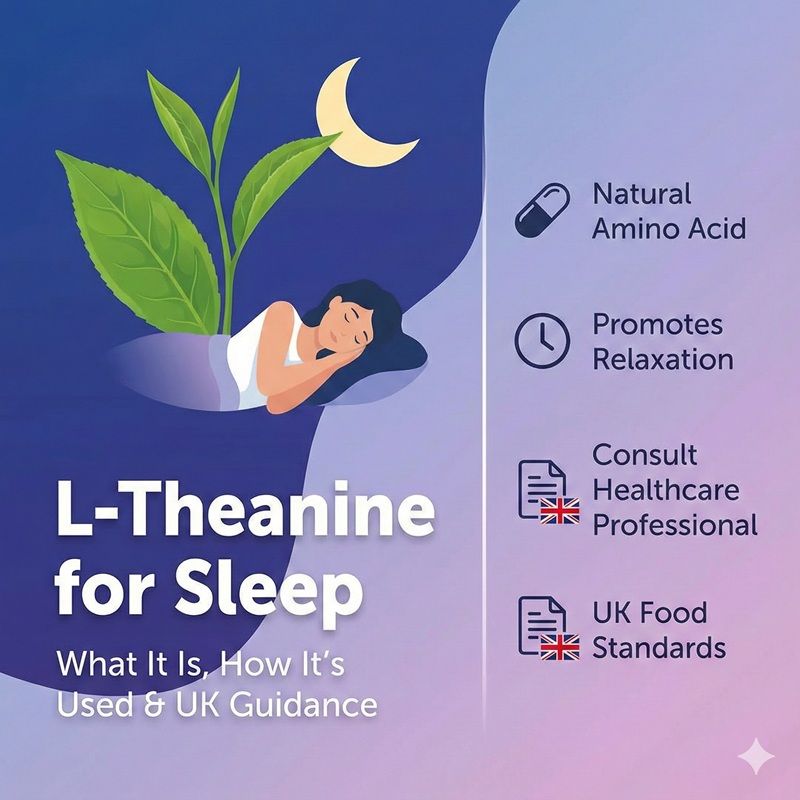
L-theanine is an amino acid naturally found in tea, particularly green tea, and is often discussed in relation to calm focus and relaxation. In supplement form, it’s commonly explored by people who feel mentally “wired” in the evening rather than physically restless.
Many people find that improving sleep isn’t always about feeling tired enough it’s about helping the mind slow down after a busy day. This is where supplements like L-theanine are often considered as part of a broader wind-down routine.
This guide explains what L-theanine is, how it’s commonly used in relation to sleep, what the evidence says, and how to compare L-theanine supplements available in the UK.

Who this is for
This article is written for:
UK adults aged 30–65
People who struggle with feeling mentally “wired” in the evening
Those exploring non-sedating supplements as part of a wind-down routine
Readers comparing L-theanine with other sleep-related supplements such as magnesium
This content is for educational purposes only and is not intended as medical advice.
What L-theanine does
L-theanine is a naturally occurring amino acid found primarily in tea leaves. It is commonly discussed in relation to:
-
relaxation without drowsiness
-
calm mental focus
-
reducing feelings of mental overstimulation
Unlike sedatives or sleep medications, L-theanine is not intended to induce sleep directly. Instead, it is often used earlier in the evening to support a calmer transition into rest.
Evidence overview (NHS / EFSA / PubMed)
NHS overview
The NHS does not provide specific guidance on L-theanine supplements. However, NHS guidance on supplements more broadly notes that many nutrients and compounds are best obtained from a balanced diet, and that supplements should be used cautiously and within recommended limits.
Source:
https://www.nhs.uk/conditions/vitamins-and-minerals/
EFSA context
The European Food Safety Authority (EFSA) has reviewed L-theanine in relation to proposed health claims. EFSA concluded that evidence was insufficient to authorise specific health claims related to stress reduction or sleep, highlighting the importance of cautious, non-claim-based use.
Source:
https://www.efsa.europa.eu/en/efsajournal/pub/2238
Research overview (high level)
Peer-reviewed research has explored L-theanine’s effects on relaxation and alpha brain wave activity. These studies often focus on calm alertness rather than sleep induction, which aligns with how L-theanine is commonly used in practice. Results vary, and findings do not support guaranteed sleep outcomes.
Best L-theanine product options (comparison table)
| Option | Form | Typical Dose Range | Pros | Cons | Where to Buy |
|---|---|---|---|---|---|
| L-Theanine capsules | Pure L-theanine | 100–200 mg | Simple, flexible dosing | Requires capsule | Amazon UK ↗ |
| L-Theanine + magnesium | Combination formula | Varies by product | Popular in evening routines | Harder to control dosage | Amazon UK ↗ |
| L-Theanine (various brands) | Capsules / tablets | Varies by brand | Wide choice, fast delivery | Quality varies | Amazon UK ↗ |
Pros & cons of L-theanine for sleep
Pros
Non-sedating
Often well tolerated
Commonly used for mental relaxation
Can be taken earlier in the evening
Cons
Not designed to induce sleep directly
Evidence for sleep outcomes is mixed
Effects vary significantly between individuals
Dosage & safety (UK guidance)
L-theanine supplements commonly provide 100–200 mg per serving, with some products offering higher amounts.
UK safety considerations:
Start with the lowest suggested dose
Follow manufacturer instructions
Avoid combining multiple calming supplements without consideration
EFSA guidance highlights the lack of authorised health claims, reinforcing the importance of cautious, non-medical use.
Where to buy L-theanine (UK)
L-theanine supplements are available On Amazon UK:
Frequently Asked Questions
Does L-theanine help you sleep?
L-theanine is not intended to make you fall asleep directly. It is commonly used to support relaxation and calm focus, which may help some people feel more settled before bed.
When should you take L-theanine for sleep?
Many people take L-theanine in the evening, often 30–90 minutes before bed, or earlier as part of a wind-down routine. Timing can vary depending on individual response.
Can you take L-theanine every day?
Some people use L-theanine regularly, but daily use should always be approached cautiously. Anyone with health conditions or concerns should consult a qualified healthcare professional.
Is L-theanine safe to combine with magnesium?
L-theanine and magnesium are sometimes combined in supplements. When combining products, total intake and individual tolerance should be considered carefully.
Final thoughts
L-theanine is often explored as part of a calm, non-sedating evening routine rather than as a direct sleep aid. While some people find it helpful for relaxation, experiences vary and evidence does not support guaranteed sleep benefits.
Understanding how L-theanine is commonly used, appropriate dosages, and UK-available options can help you decide whether it fits into your routine.
Sources & references
NHS – Vitamins and minerals guidance
https://www.nhs.uk/conditions/vitamins-and-minerals/European Food Safety Authority (EFSA) – Scientific opinion on L-theanine health claims
https://www.efsa.europa.eu/en/efsajournal/pub/2238Peer-reviewed research summaries on amino acids and relaxation
